

Canada could reap trade opportunities from the potential multibillion-dollar port fee fiasco seeking berth space along the U.S. waterfront.
However, that assumes Canada still has the grit and determination to be a country.
If it does, it will need a population prepared to do more than hold out hands for help and leadership selling more than short-term detours around economic and political spike belts.
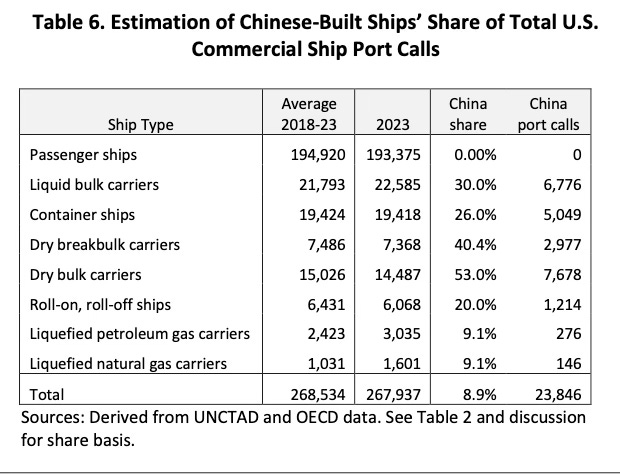
The supply chain efficiency and consumer costs of U.S. port levies targeting ships built in China was chronicled in a recently released Trade Partnership Worldwide LLC (TPW) report commissioned by the National Retail Federation and the Retail Industry Leaders Association.
Overall, the report assessing the fallout from the U.S. Trade Representative’s (USTR) proposed levies on ships built in China entering and exiting U.S. ports found that the USTR’s proposed actions “would have far-reaching negative effects on the prices of imports and exports.”
Aside from trying to restore North America’s lost ability to build ships competitively –which is a long shot by any measure – the USTR is proposing to levy service fees of up to US$1 million per Chinese vessel entering U.S. ports. Ocean carriers with fleets of Chinese-built ships would also be facing service fees of up to US$1.5 million.
The USTR also wants at least 1% of all U.S. exports to be carried on U.S.-flagged and operated ships now and aims to raise that to 15% over the next seven years.
Its proposals are in response to a March 2024 petition from five unions claiming that the predatory policies and actions of the Chinese Communist Party have distorted the global market unfairly in favour of China’s shipbuilding and global shipping sectors to such an extent that the U.S. commercial shipbuilding sector cannot compete internationally.
The unions’ claims are valid.
China’s state-funded market cost and competition distortions and its deep pool of forced labour and non-market pricing for steel and other raw materials have eliminated any competition that might abide by international free-market rules and principles.
USTR actions would benefit some portions of North America’s commercial shipbuilding sector.
However, as the TPW study points out, that sector’s capacity and costs are no longer competitive internationally.
Consider, for example, that an estimated 74% of U.S. shipbuilding construction and repair revenue comes from the U.S. Navy. The TPW report notes that America’s 30-year shipbuilding plan calls for the construction of hundreds of vessels for the U.S. Navy by 2054.
That leaves no meaningful capacity to build ships for the commercial sector.
Also, labour and other costs make ships built in the U.S. up to “four or more times the world price.”
The average annual wage for shipbuilding’s production workers in the U.S., according to the TPW report, was 20.4% higher in 2023 than it was in 2018.
Meanwhile, President Donald Trump’s latest round of tariffs will further inflate the cost of steel and aluminum, both of which are already expensive.
The TPW report notes that prices for U.S.-made fabricated metal plate work were 49% higher in 2023 than they were in 2018 when the first round of steel and aluminum tariffs were instituted by the Trump administration.
So, the USTR proposal to penalize shipping companies and ocean carriers using China-built ships opens a couple of windows of opportunity for an alert and agile Canada to win market share at the expense of American trade aggression:
•Canada offers an alternative North American entry point for shipping lines looking to reduce U.S. port call frequency and variety to reduce port entry penalties;
•U.S. retailers and other importers could also look to Canada and Mexico to source goods and resources to avoid those port fees.
But those opportunities can only be exploited if Canada recovers the focus and fortitude it needs to reclaim its productivity potential, investment appeal and economic intelligence.
The April 28 federal election will go a long way to determining whether Canada has the citizenry and political leadership willing to do the work and make the difficult decisions that reclamation project requires.
www.linkedin.com/in/timothyrenshaw
@trenshaw24.bsky.social
@timothyrenshaw