
Rare sightings during Substack Shipping News’ New Zealand road trip: electric cars and Canadian moose
North America’s EV sales suffer steep downhill skid to start 2026 as Western carmakers brace for China’s next wave of electric vehicle exports

Rotorua, New Zealand: Pondering transportation’s progress along Electric Avenue during a Substack Shipping News (SSN) New Zealand road trip, we find fossil fuel molecules still miles ahead of electrodes in Australasia.
EV sightings on New Zealand’s South Island were as rare as sightings of the descendants of the 10 Canadian moose released into South Island wilderness in 1910 as part of an initiative to establish big game hunting in a land where there is no indigenous big game.
Sadly, there have been no reliably verified moose sightings since the 1950s, even though there is now a NZ$10,000 reward for anyone providing video or other evidence of moose survival in New Zealand.
There are no natural predators threatening that moose survival on either south or north island New Zealand, but electric car market predators abound down-under, as China accelerates its campaign of world domination in EV sales and manufacturing.
Meanwhile, EV adoption news in the West, especially in the United States, is bleak.
According to January numbers compiled by Cox Automotive, January’s sales of new EVs in the U.S. were down 29.9% compared with the same month a year ago. The 66,276 units sold also represented a 20.4% month-over-month decrease.
Total new-car market share for EVs in the U.S. has dropped to 6% this year; last year the sector was closing in on 10%.
Major car makers have also been eating multibillion-dollar write-downs on their ambitious electric vehicle transition strategies – US$60 billion over the past year, according to some estimates.
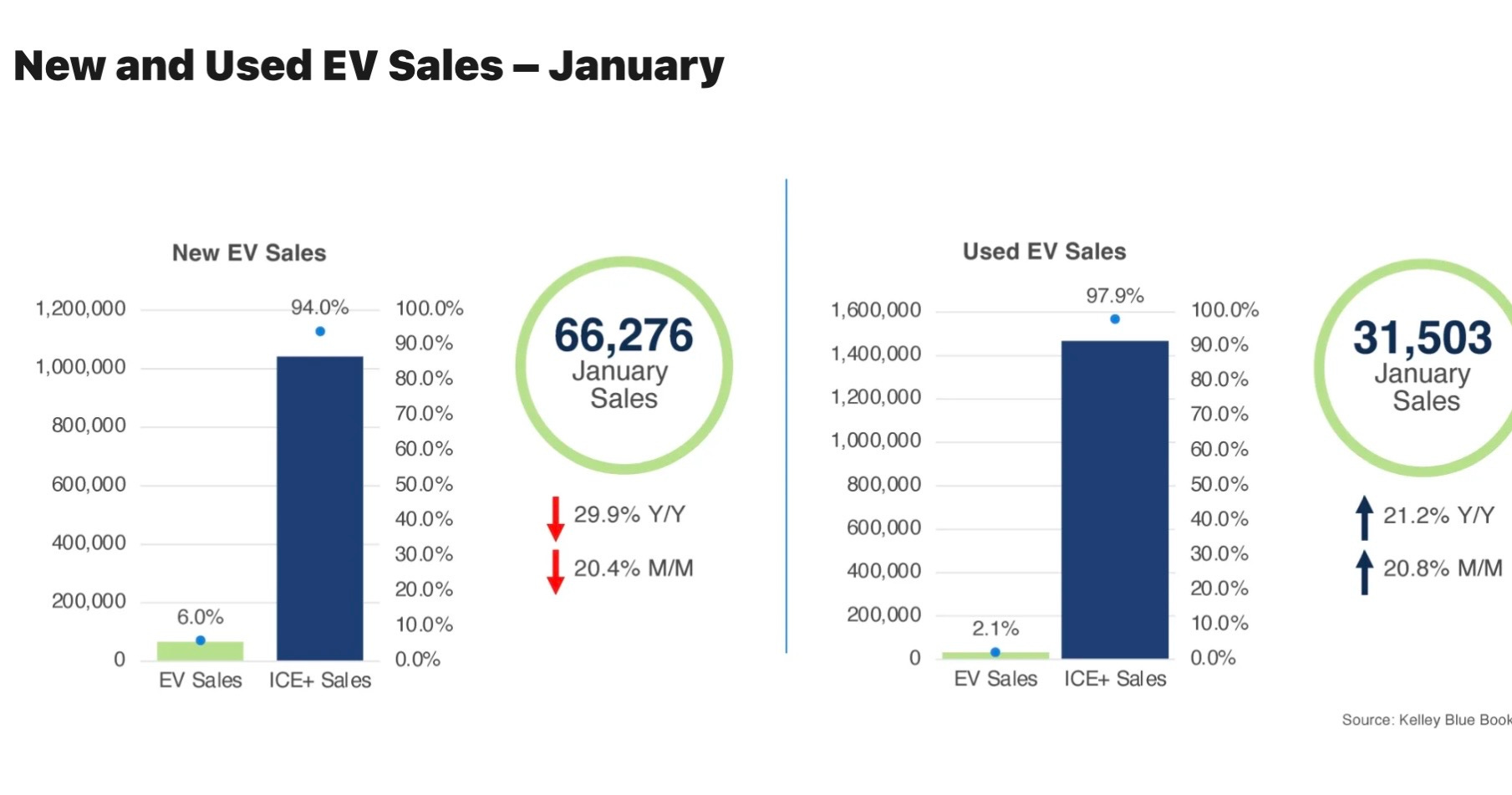
North America’s electric vehicle sales dipped sharply in January, according to a recent report from a leading a U.S.-based automotive services and technology company | Cox Automotive
January’s numbers continued that EV sales free fall.
The Cox report showed Ford’s [NYSE:F] EV sales nose-diving close to 60% month over month to a scant 2,174 units.
Tesla’s [TSX:T] sales dropped 17%, but the company increased its market share to 60.5% from December’s 57.3% – mainly because, as Cox pointed out, other major carmakers have suffered far worse EV sales declines.
Meanwhile, China’s carmakers continue to make deep EV sales market inroads at home and abroad.
As SSN previously noted, electric vehicles now account for 50% of the country’s domestic car sales, which six years ago included around 1 million EVs. Today that number is just over 12 million.
Nearly 60% of car models for sale in China are EVs. That, according to the International Energy Agency, is five times the number available in the United States.
China’s offering of a wide range of cheaper, sub-luxury EV models is one of the key drivers of its electric vehicle sales and why China has all but eliminated the price gap between EVs and their internal combustion engine (ICE) counterparts.
So, electrodes remain very much in the mass market transportation game.
Cox numbers show January’s used EV sales (31,503 units) up 21.2% compared with the same month a year ago and up 20.8% from December.
And down here in New Zealand an estimated 50% of new car sales are now EVs.
Realistically, transportation’s electrification was never a fast-lane fix. Neither should it be peddled as the only energy transition option.
The battery-range technology and recharging infrastructure availability equation has always needed to equal fossil fuel’s range and refuelling convenience.
Comparative EV-vs.-ICE costs of ownership also need to make dollars and sense to consumers.
Gaps continue to close on those fronts.
However, shifting to a quieter, more energy efficient, less maintenance-dependent, and more technically advanced transportation alternative will be a long-term proposition.
The market, as always, will determine how long that term will be.
www.linkedin.com/in/timothyrenshaw
@trenshaw24.bsky.social
@timothyrenshaw